

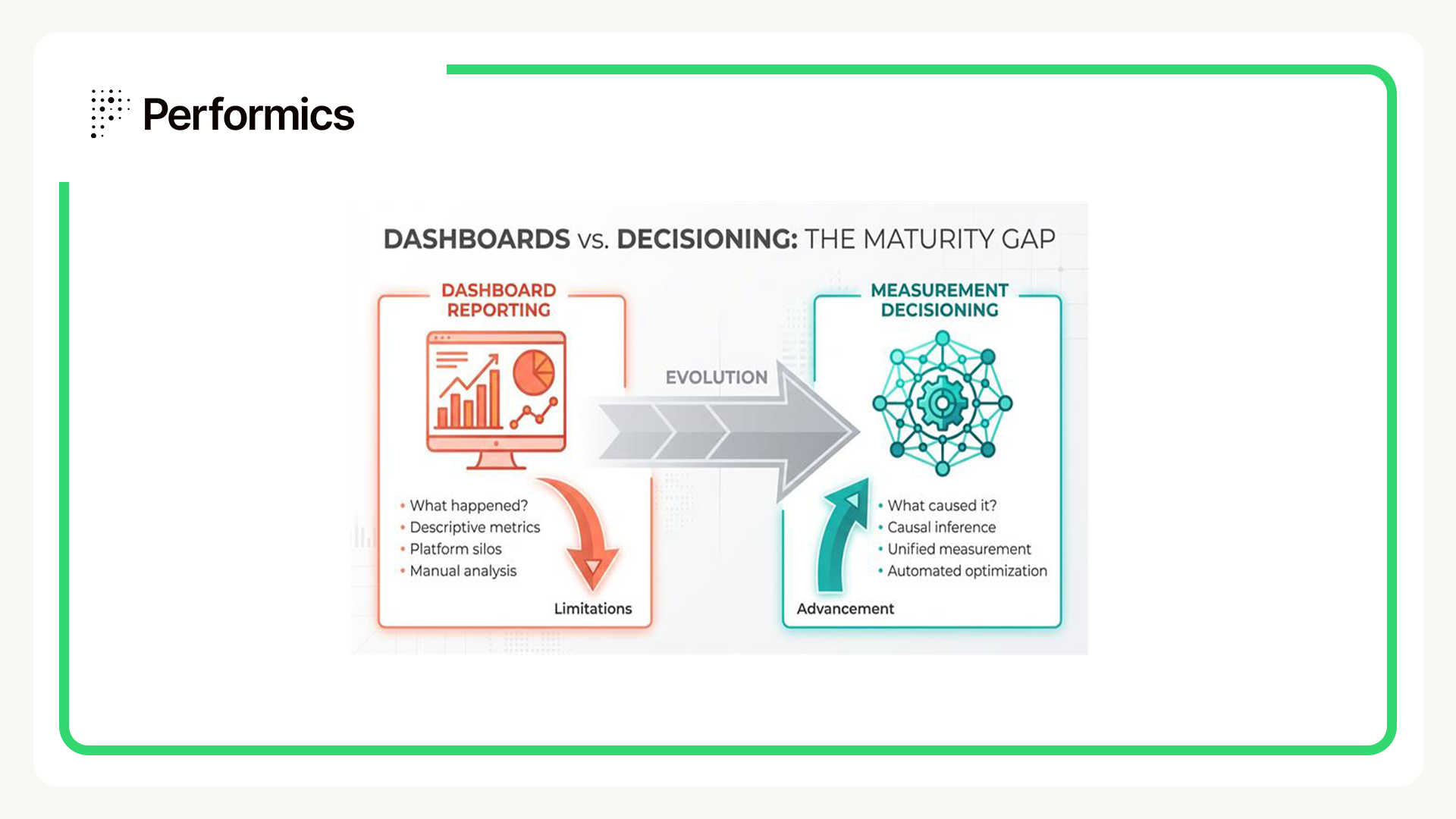
Most marketing organisations today operate with sophisticated dashboards. Real-time metrics, elegant visualisations, executive summaries. On the surface, everything appears under control. Yet beneath the green arrows and upward curves lies a quieter, more consequential problem. Visibility has replaced understanding.
This is the Theatre of Analytics, a world where performance looks impressive, but decision-making remains fragile.
Traffic rises week-on-week. Costs appear efficient. Yet when leadership asks why growth occurred, or what would happen if budgets were slashed, answers often fall apart. Dashboards function like thermometers. They indicate a fever, but they do not treat it. Measurement, by contrast, should operate like a climate system, regulating outcomes against intent. The gap between observation and intervention is where modern marketing organisations lose control. This disconnect creates a measurement maturity gap that many organisations fail to recognise until the cost becomes material. On one side sits dashboard reporting: descriptive, backward-looking, focused on what happened. On the other sits measurement-led decisioning: predictive, forward-looking, designed to guide what should happen next. The distance between the two is not theoretical. It is where millions are misallocated, not only through wasted media spend, but through opportunities never identified or acted upon.
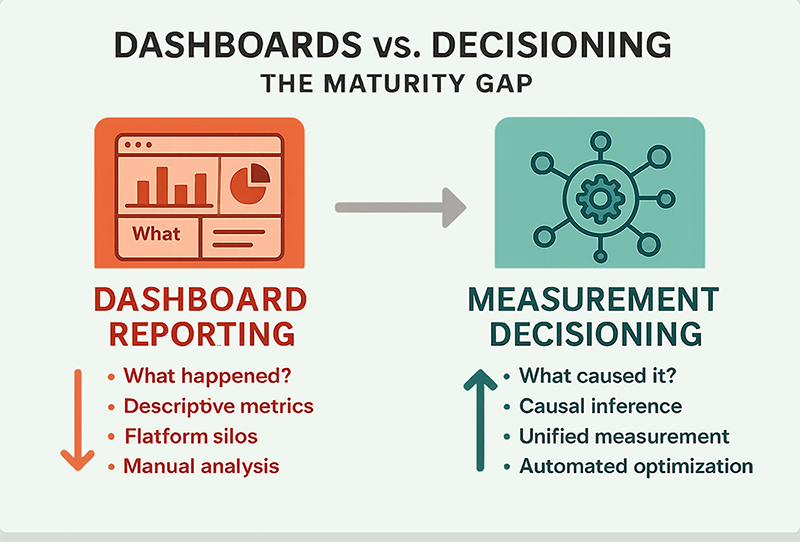
Figure 1: The Maturity Gap – Dashboard Reporting vs. Measurement Decisioning
Closing this gap does not require more tools. It requires a different way of thinking about measurement altogether.
The Hidden Cost of Measurement Immaturity
Measurement immaturity rarely announces itself as failure. It often masquerades as success.
In one instance, a high-growth SaaS organisation reported record volumes of Marketing Qualified Leads alongside historically low Customer Acquisition Costs. Platform-level attribution painted a compelling picture of efficiency and scale. Performance dashboards suggested the business had cracked the growth code.
However, our deeper measurement audit told a different story. The same users were being claimed across multiple platforms, with paid social, search, and lifecycle channels each taking credit for identical conversions. Demand capture was being mistaken for demand creation. Once duplication was resolved, true acquisition costs were nearly three times higher than reported.
The organisation had not made a single bad decision. It had made many decisions based on an incomplete truth.
This is how measurement immaturity compounds. Optimisation reinforces flawed assumptions. Budgets chase signals that look productive but contribute little incremental value. Over time, strategies drift further from reality, anchored to performance narratives that dashboards cannot challenge.
Platform attribution, when treated as the sole source of truth, becomes persuasion rather than proof.
Three Questions That Define Measurement Maturity
Escaping the dashboard trap requires more than maturity models that count tools or data points. Measurement maturity reveals itself in the ability to answer three fundamental questions.
Can performance be observed accurately? (Observation)
At the foundation sits observation. Clean, deduplicated data remains the prerequisite for everything that follows. Privacy changes, signal loss, and fragmented data capture have made this increasingly difficult. Without confidence in the numbers, optimisation becomes guesswork.
Can outcomes be attributed to causes? (Causation)
This is the most difficult leap. Correlation offers comfort but little certainty. A click before conversion does not prove influence. Incrementality testing, log-level analysis via Data Clean Room technology and Marketing Mix Modelling allow organisations to separate coincidence from contribution, shifting focus from who claimed credit to what created value.
Can insight be activated systematically? (Activation)
Insight without execution creates friction, not advantage. Mature measurement systems inform bids, pacing, and investment decisions in real time. The objective is not better reporting, but better outcomes.
Together, observation, causation, and activation form the backbone of decision-grade measurement.
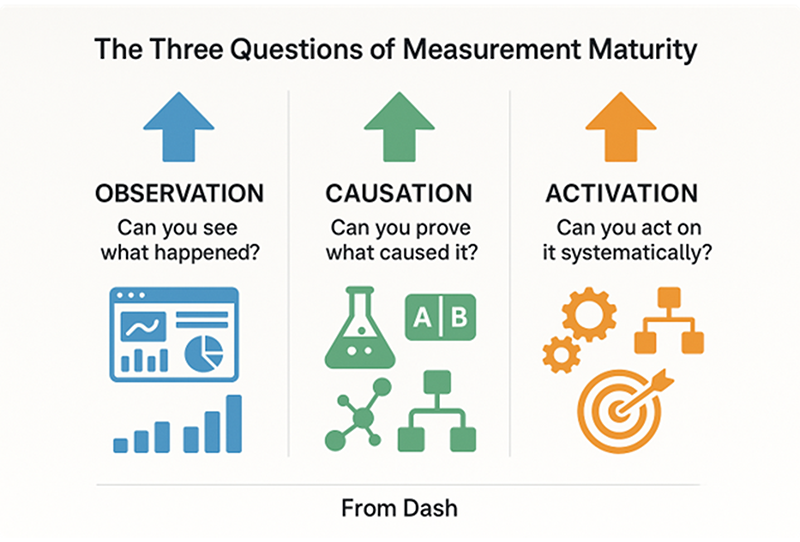
Figure 2: The Three Questions of Measurement Maturity
Measurement Must Follow the Funnel
What many frameworks overlook is context. Measurement priorities differ based on where growth pressure sits within the funnel. Awareness-led strategies demand different proof than conversion or retention-led models. Measurement should follow business intent, not platform capability.
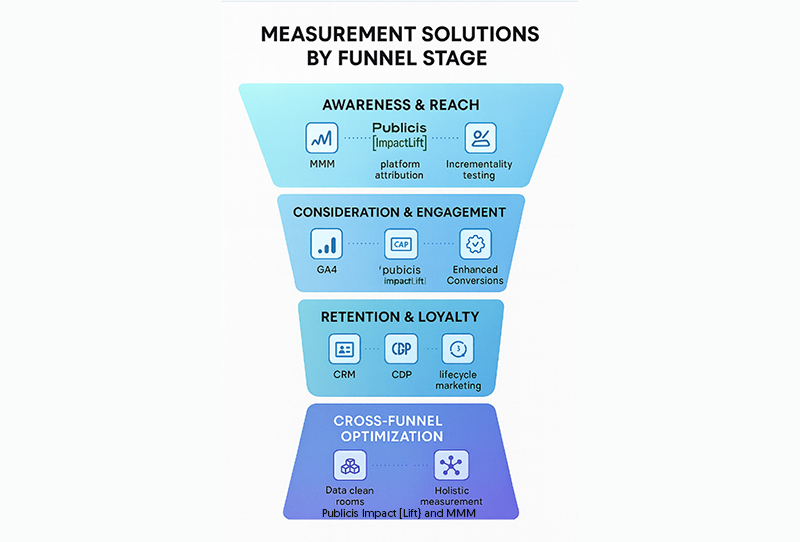
Figure 3: Measurement Solutions Mapped to Marketing Funnel Stages
Awareness and Reach (Top of the Funnel)
At the top of the funnel, the question is not volume but quality.
“Did campaigns reach the right audiences, and did they create meaningful lift?”
In one consumer goods engagement, this clarity fundamentally reshaped investment decisions. Marketing Mix Modelling (MMM), and Platform attribution via Data Clean Room simultaneously revealed that OTT delivered diminishing returns beyond a defined spend threshold, even as connected YouTube video environments remained underweighted. What appeared efficient on dashboards was masking saturation. By rebalancing the channel mix towards high-attention digital video while rationalizing excess OTT spend, the brand increased aided awareness by double digits and reduced overall investment. Without causal measurement, this opportunity would have remained invisible, buried beneath aggregate reach numbers.
Reaching people is only the starting point. Once awareness is established, the challenge shifts from exposure to engagement. The next question becomes not how many people saw the message, but whether the message resonated with the audiences that matter most.
Consideration and Engagement (Mid Funnel)
As journeys deepen, audience engagement quality overtakes surface-level metrics as the true indicator of effectiveness. At this stage, not all audience interactions signal intent equally, and treating them as such leads to distorted optimisation decisions. What matters is the ability to distinguish passive consumption from meaningful engagement that advances decision-making.
This distinction became clear in our work with a B2B technology brand, where deeper measurement via event- based analytics and MTA revealed that prospects interacting with decision-support tools were far more likely to convert than those engaging only with passive content. With this clarity, the brand reoriented its mid-funnel strategy away from broad content volume and towards high-intent experiences designed to support evaluation and choice. The outcome was not just improved conversion efficiency, but a measurable improvement in lead quality alongside reduced acquisition costs.
Conversion & Acquisition (Bottom of Funnel)
At the bottom of the funnel, the question shifts from visibility and engagement to truth.
“Which touchpoints genuinely drive conversions, and how accurately are those outcomes being captured and attributed?”
This is where weaknesses in measurement become most exposed. Signal loss, fragmented identity, and platform-level reporting routinely distort reality, creating a false sense of efficiency. Without resilient conversion infrastructure, brands optimise against incomplete or duplicated signals, mistaking attribution for impact.
In one e-commerce engagement, strengthening this foundation fundamentally reshaped decision-making. By implementing server-side tracking alongside Conversions API and enhanced conversion frameworks, the brand uncovered two critical issues: a meaningful share of conversions was going unrecorded, while another set was being counted multiple times across platforms due to poor deduplication. Channels that appeared to perform well were benefiting from attribution overlap rather than creating genuine demand by utilizing Data Clean Room technology. Once these distortions were resolved, the true drivers of conversion became clear, enabling budgets to be reallocated with confidence.
At this stage, mature and full-funnel measurement focuses on validating true conversion paths, restoring lost signals, and resolving identity across touchpoints. For performance-led organisations operating in high-investment, direct-response environments, this discipline is non-negotiable.
Building Measurement Muscle
Measurement maturity builds through progressive capability rather than sudden transformation. It begins with establishing resilient data infrastructure, consistent taxonomies, and reliable signal capture. Without this foundation, any added sophistication quickly collapses under its own weight.
From there, organisations must prove causation through disciplined experimentation, lift testing, and calibration that establish ground truths beyond platform-led narratives. Once causality is clear, scale becomes possible. Portfolio-level modelling and optimisation then reveal diminishing returns and investment trade-offs across channels.
The final step is best practices and activation, where insight moves out of reports and into execution systems, ensuring that learning directly influences how budgets shift and decisions are made. Together, these stages transform measurement from retrospective reporting into a durable engine for growth.
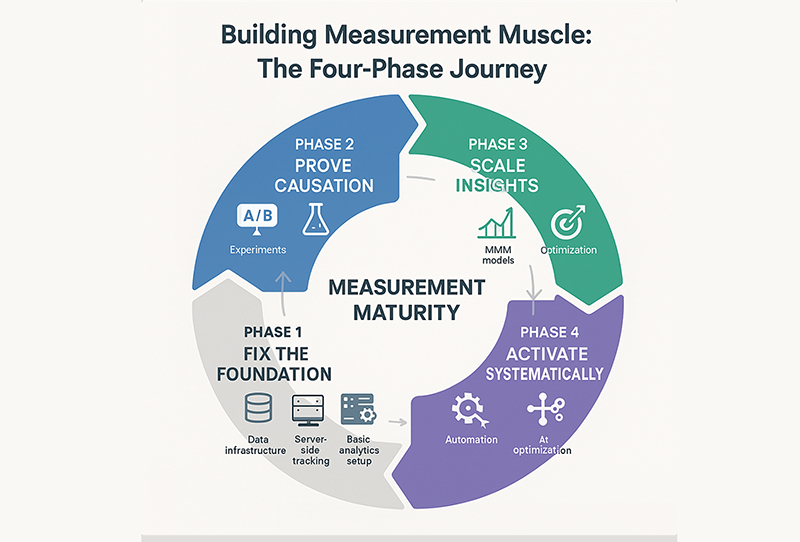
Figure 5: Building Measurement Muscle – The Four-Phase Journey
The Future of Measurement
Measurement and activation are rapidly converging. AI-driven systems now identify anomalies, diagnose root causes, and initiate corrective action with minimal human intervention. Real-time attribution is replacing quarterly hindsight.
In this environment, advantage will not accrue to organisations with the most dashboards, but to those that translate causal truth into decisive action at speed. Measurement maturity is not defined by sophistication alone, but by velocity, the pace at which insight becomes impact.
Dashboards will continue to play a role, but they should no longer serve as the destination. They must function as the starting point for better decisions and stronger outcomes.
About the author:
Swati Gupta is Director-Analytics | Head- Impact Measurement, MarTech at Publicis Media.
India